
New rankings score colleges on merit, academic rigor, free speech
New university rankings from the City Journal highlight a growing divide between institutions that prioritize affordability and academic standards and those that maintain higher costs and politicized agendas.
New rankings from the Manhattan Institute’s City Journal measure 100 colleges for meritocracy, free speech, academic rigor, and value of a degree.
The University of Florida (UF) takes the #1 spot as Ivy League institutions fall behind.
UF has earned its top ranking by eliminating its diversity, equity, and inclusion (DEI) bureaucracy, enforcing standardized test requirements in admissions, and building its dedicated civics institute, the Hamilton School for Classical and Civic Education.
Schools received lower scores for requiring DEI courses or DEI statements in hiring, promoting political activism like pronouns on class rosters, or failing to control violent campus antisemitism. The rankings also evaluated institutional neutrality, viewpoint diversity, and civic education.
Ivy League institutions performed poorly across these metrics, sinking to an average ranking of #42 while charging an average tuition price of $67,600 per year.
By contrast, UF stands out as one of the most affordable four-year institutions in the nation, with estimated annual tuition of $6,400 for in-state students and $30,900 for out-of-state students.
[RELATED: Florida tops higher ed rankings for 10th year as DeSantis dismantles DEI]
Florida State University (FSU) has also secured a top ten spot, coming in seventh overall. Its ranking was also driven by its standardized test requirements, efforts to scale back DEI, and decisive actions against violent antisemitism.
FSU offers the most affordable tuition on the list, charging an estimated $5,600 for in-state students and $20,100 for out-of-state students.
All eight Ivy League schools lagged behind and charge significantly higher tuition.
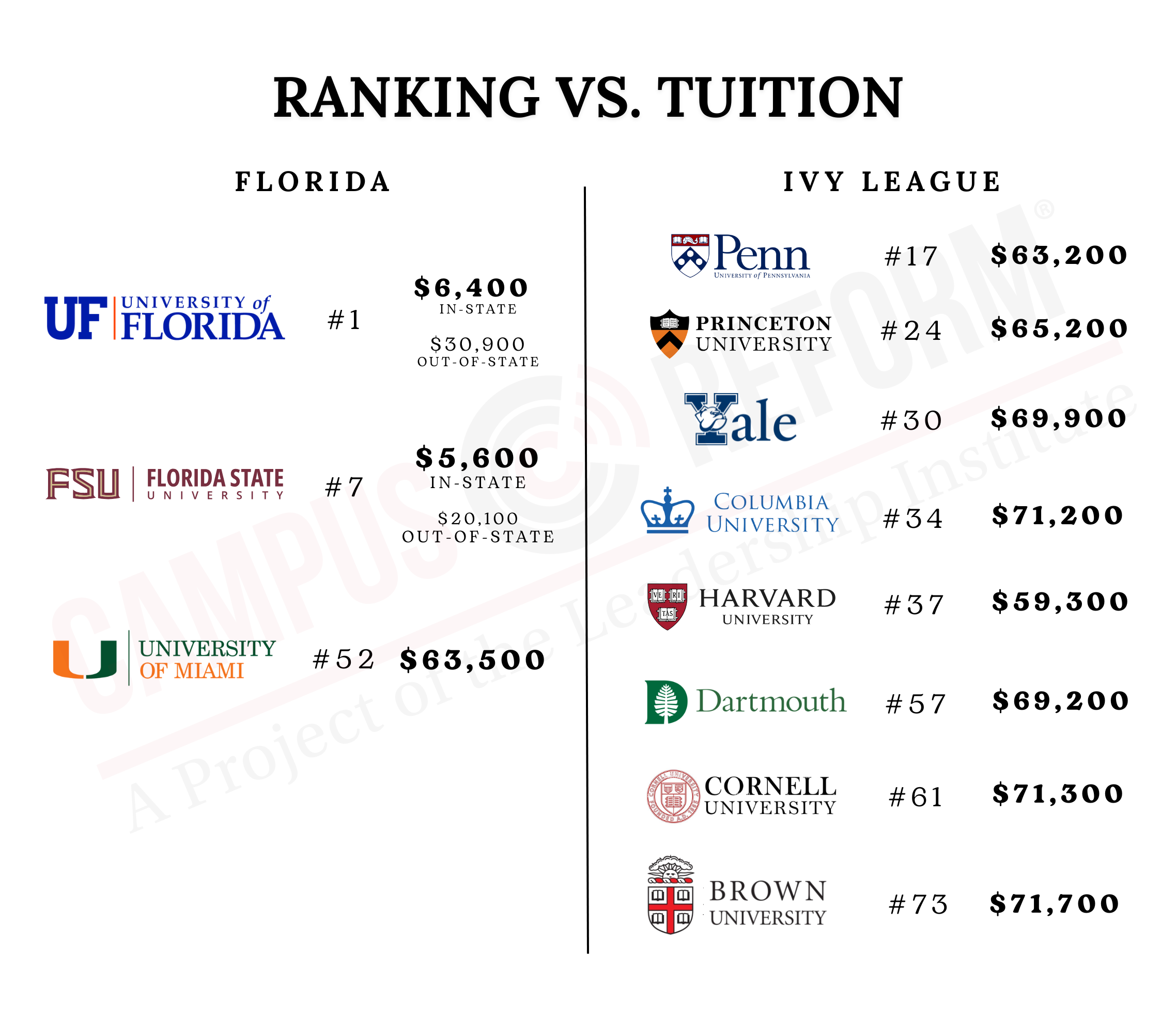 Sources: The City Journal’s 2025 College Rankings; tuition estimates obtained from official university websites.
The rankings also include a “Jewish Campus Climate” metric, which assigned lowered scores to schools with antisemitic incidents, pro-Hamas student groups, and faculty support for pro-Hamas groups.
City Journal highlighted UF’s use of law enforcement to “swiftly” dismantle anti-Israel protest encampments and called the response evidence of a “welcoming and tolerant climate for Jewish students.”
All eight Ivies received lower rankings due to their administrations’ failures to shut down violent antisemitic protests and prevent the harassment of Jewish students after Hamas’ Oct. 7 terror attacks on Israel. University presidents at Columbia University and University of Pennsylvania (UPenn) resigned in the wake of these controversies. Cornell University had one of the longest pro-Hamas encampments among the schools reviewed.
The Trump administration is still investigating several Ivy League universities over their handling of antisemitic violence.
DEI policies also contribute to low scores. Yale University reportedly employs about 16 DEI staff per 1,000 students, and Dartmouth College requires DEI statements in nearly 85% of job postings. Additionally, all Ivy League schools filed amicus briefs in support of race-based affirmative action in the 2023 Supreme Court case, which the City Journal calls evidence that these institutions “value diversity over merit in admissions.”
City Journal also pointed to university commitments to activist causes, such as Harvard’s encouragement of preferred pronouns and a university-wide land acknowledgment. Harvard ranks in 96th place for the category of “student political tolerance.”
Free speech controversies further harm Ivy League rankings. Princeton University received a “red” free speech rating from the Foundation for Individual Rights and Expression (FIRE). At Columbia, only 20% of surveyed students reportedly told FIRE that their university values free expression.
Overall, the City Journal’s report highlights a growing divide between institutions that prioritize affordability and academic standards and those that maintain higher costs and politicized agendas.
Per the City Journal’s rankings, Florida’s public universities outpaced elite private institutions by offering lower tuition alongside a clearer focus on academic rigor and merit-based policies.
Editor’s note: This article has been updated to provide additional clarity.